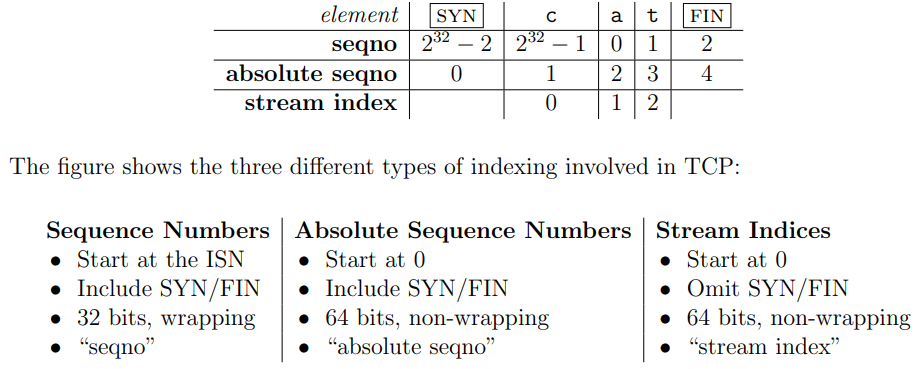
//! Transform an "absolute" 64-bit sequence number (zero-indexed) into a WrappingInt32 //! \param n The input absolute 64-bit sequence number //! \param isn The initial sequence number WrappingInt32 wrap(uint64_t n, WrappingInt32 isn){ return isn + static_cast<uint32_t>(n); }
//! Transform a WrappingInt32 into an "absolute" 64-bit sequence number (zero-indexed) //! \param n The relative sequence number //! \param isn The initial sequence number //! \param checkpoint A recent absolute 64-bit sequence number //! \returns the 64-bit sequence number that wraps to `n` and is closest to `checkpoint` //! //! \note Each of the two streams of the TCP connection has its own ISN. One stream //! runs from the local TCPSender to the remote TCPReceiver and has one ISN, //! and the other stream runs from the remote TCPSender to the local TCPReceiver and //! has a different ISN. uint64_tunwrap(WrappingInt32 n, WrappingInt32 isn, uint64_t checkpoint){ // n 可以在 checkpoint 的左边,也可以在 checkpoint 的右边, // 留意无符号数相减求偏移量,例如: // n 为 1,checkpoint 为 7,1 - 7 等于 1<<32 + 1 - 7 // 所以如果新位置距离 checkpoint 的偏移量大于 1<<32 的一半,即 1<<31 // 那么离 checkpoint 最近的位置实际上是在 checkpoint 的左侧
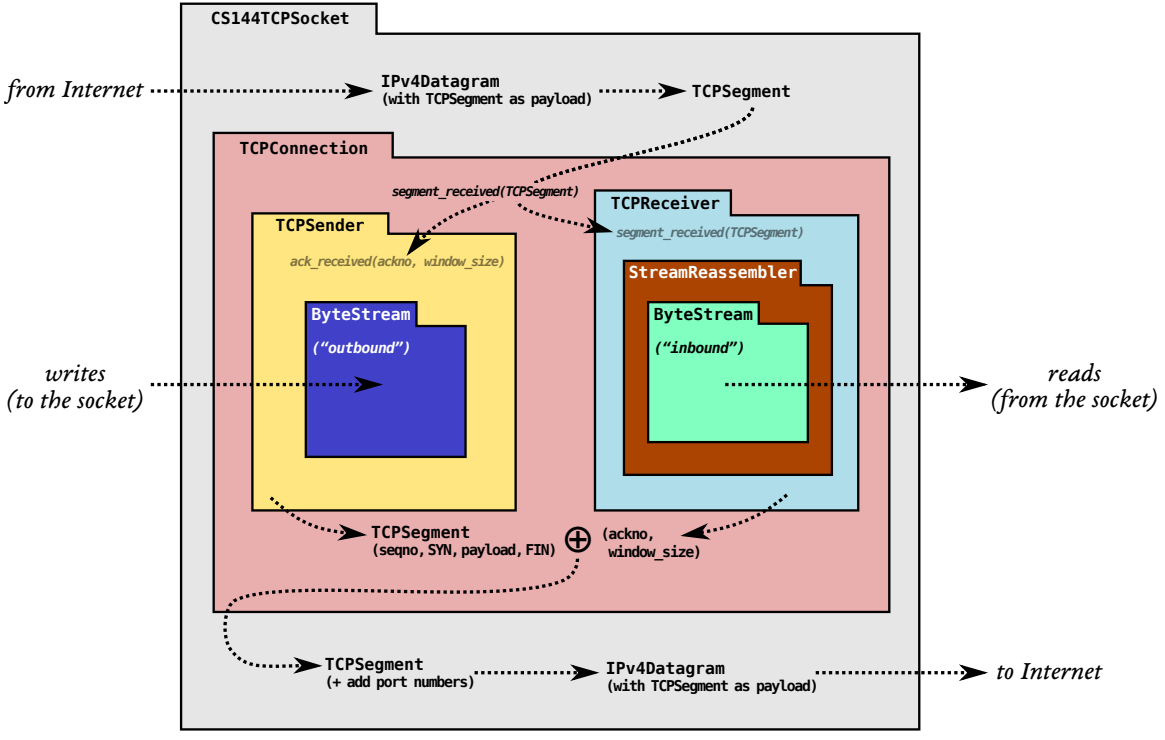
// ... classTCPReceiver { //! Our data structure for re-assembling bytes. StreamReassembler _reassembler;
//! The maximum number of bytes we'll store. size_t _capacity;
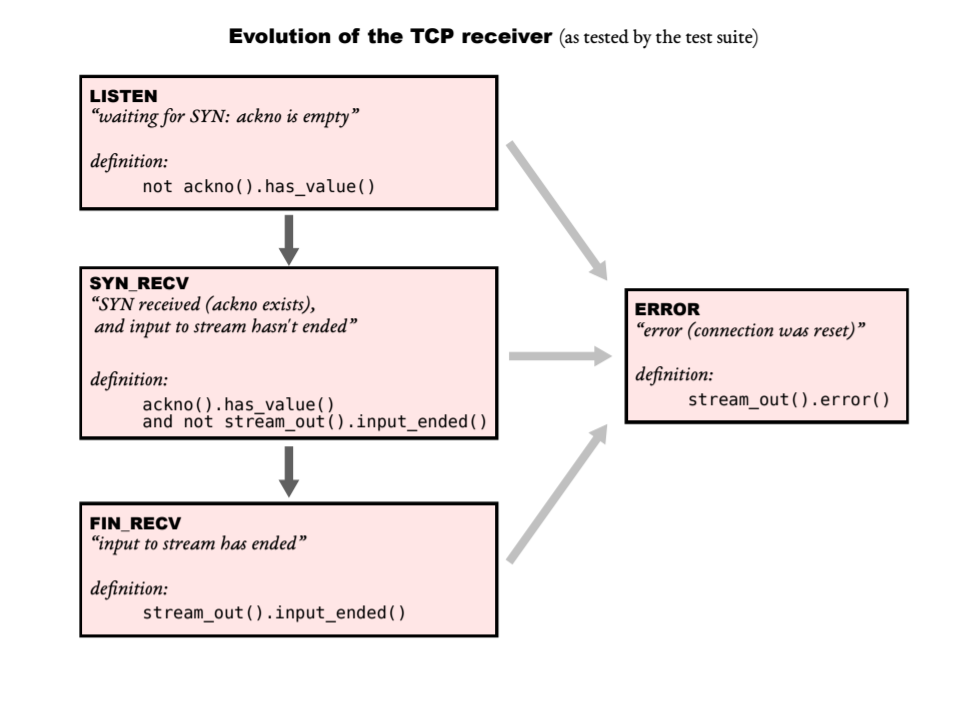
bool _syn_flag; WrappingInt32 _isn;
public: //! \brief Construct a TCP receiver //! //! \param capacity the maximum number of bytes that the receiver will //! store in its buffers at any give time. TCPReceiver(constsize_t capacity) : _reassembler(capacity), _capacity(capacity), _syn_flag(false), _isn(0) {}